Tools & Resources



[Tools & Resources]
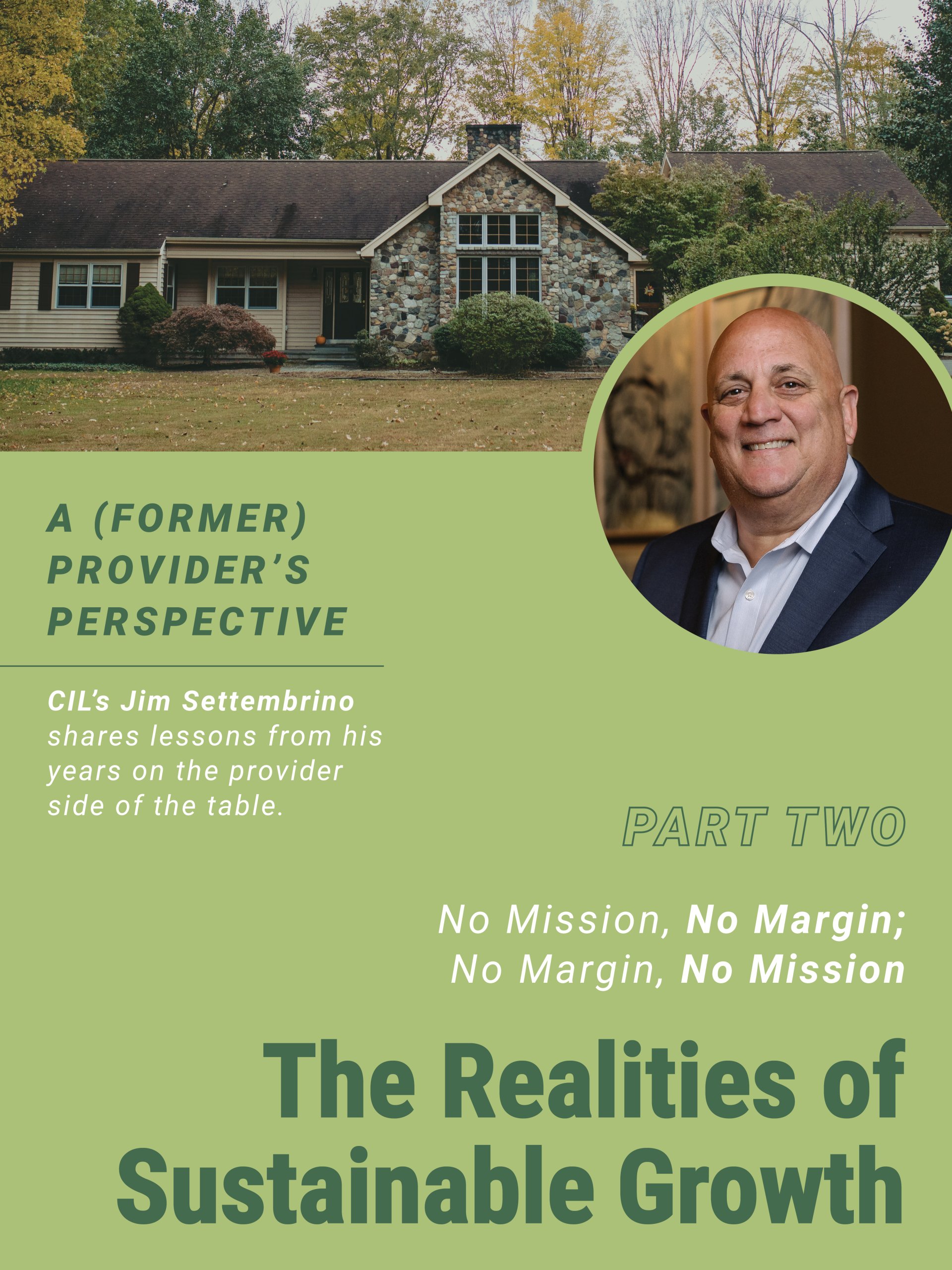
"No Mission, No Margin; No Margin, No Mission"
The Realities of Sustainable Growth
There is a phrase I’ve heard for years in the provider world—one that tends to resurface whenever discussions about growth are on the table:
“No mission, no margin; no margin, no mission.”
It’s simple, but I believe it carries weight. For organizations serving individuals with intellectual and developmental disabilities, expansion is a balancing act that touches everything from quality of care to financial stability to the culture that holds it all together.
Growth is often measured in percentages—number of homes, number of people. There’s nothing personal about that. It’s a plain business approach. Yet, the work itself is deeply personal. Providers are drawn in by the mission—supporting people, creating opportunity and environments where individuals can live independently. That mission helps shape conversations in boardrooms, attracts staff, and defines how organizations present themselves. Somewhere between those two poles is where growth either works or begins to strain.
I’ve seen how leadership pressure can tilt that balance. When the focus leans too heavily toward financial performance, cracks tend to show in the quality of support. The opposite carries its own risks. Without a stable operational foundation, even the most mission-driven organization can struggle to sustain itself.
For providers considering expansion, the hesitation is rarely about ambition. More often, it’s rooted in an understanding of what growth actually demands. One of the biggest questions is internal: how much can the organization realistically take on? There’s a lot more that goes into serving individuals than just boots on the ground. Supervision, administration, infrastructure—it all has to scale with you.
That leads to a second concern: bandwidth. Recruiting, training, and leadership alignment aren’t things you can rush. Growth that outpaces the team behind it tends to show up quickly. At the same time, providers feel a constant pull to do more. The outcome of good services is more requests. You want to help everyone. That instinct is part of what makes the work meaningful. It’s also where organizations can begin to stretch themselves thin. What started as thoughtful expansion can start to feel reactive.
And then there’s funding—how to grow in a way that reaches more people without sacrificing the quality of support already in place. The most sustainable growth I’ve seen has rarely been rapid. There was purpose behind it. Without that anchor, it becomes easier for people to turn into numbers as organizations scale. Staying connected to the mission in a real way takes effort.
At the same time, the operational side of growth doesn’t go away. The challenge is finding ways to support that side of the business without pulling focus away from the people at the center of it. One way providers manage that tension is by looking carefully at where they need help. There are so many facets to delivering comprehensive services, and if you can take some of that weight off your team, it allows them to stay focused on what they do best.
That might mean rethinking responsibilities or finding partners who can take on work that would otherwise drain internal time and resources. Not as a shortcut, but as a way to protect both sides of the equation. Because regardless of size, the same tension remains.
No mission, no margin; no margin, no mission. You don’t get to leave either side behind.
Please contact us here if we can make this page more accessible for you.